
Acts · estates
Déclaration de transmission: a property passes to the heirs.
The owner has died and their property passes to the heirs. Often several, often far away, with a house they didn’t choose. It’s the largest source of files in the register, and the only one that gets better with age.
- Who publishes it
- The estate’s notary, on the heirs’ behalf.
- The deadline
- None. An estate ripens over the months.
- Who you talk to
- The heirs, or the liquidator.
- The potential
- The largest volume in the register, read with the clues.
What the act says
The déclaration de transmission records in the register that the deceased’s property now belongs to their heirs, by will or by law. It names the deceased, the heirs and often the liquidator: the person in charge of settling the estate.
The heirs need it to sell or mortgage the property. When the declaration, a sale and a new mortgage are all published the same day, the family has already sorted it out: that’s not a file.
How an estate unfolds
Day 0
The death
The date doesn’t go through the register.
The first months
Settling the estate
The liquidator takes inventory, pays the debts, prepares the division. About six months, and nothing is registered.
~ 6 months
The déclaration de transmission is publishedYour window
The heirs become the owners. Mon Prospecteur sends it to you the same day.
6 to 18 months
The estate ripens
Taxes, insurance, heating and upkeep on an empty house add up. A winter later, the heir who looked after it alone is often ready to sell.
Then
Sell, divide or keep
Nothing forces a choice, and nothing is registered ahead of time: only a conversation will tell you what the heirs decided.
Unlike a préavis, an estate doesn’t expire: a declaration from a year ago can be worth more than yesterday’s. Keep it in your follow-ups.
What the heirs are going through
Inheriting a house often means inheriting a pile of trouble. There are sometimes several heirs, not always in agreement; they live elsewhere; the house is full of memories and belongings; it needs work; and it costs money every month, even empty.
It’s a lot easier to split cash than to divide a house in three. A simple, quick sale, without endless showings, often suits everyone.
Signs of a good file
- Several heirs: more people to agree, and more reason to sell and split.
- No heir lives at the property: nobody is attached to it day to day.
- A mortgage still to carry: payments that continue on a house nobody lives in.
- A paid-off house: plenty of equity, so room to negotiate.
- An older house, needing work or full of memories.
- On the other hand, a surviving spouse living in the house isn’t in a hurry. Write gently, and come back in six months or a year.
What it opens up for you
Sellers who didn’t choose to be owners, and who mostly want it simple. And volume: hundreds of declarations every week in Québec, enough to build a steady follow-up. You can offer:
- A purchase as is, on the date that suits them, with no showings or repairs.
- One offer for all the heirs, settled at the notary’s: each receives their share in cash.
- For a broker: a listing, with someone guiding them from start to finish.
How to approach it
With tact. The loss may be recent: a short, respectful letter offering a simple solution beats an insistent call.
Then with patience. Many estates are decided months later: spaced-out follow-ups over six months to a year often make the difference. An heir who wasn’t ready in the spring may be after the winter.
Write to each heir, or to the liquidator when no heir has a known address.
A distinction that matters: the mortgage claim
A “déclaration de transmission – créance hypothécaire” isn’t an estate of a property. The deceased was a lender: their heirs inherited the right to be repaid by someone else. The property’s owner hasn’t died and isn’t selling.
So don’t write to them about “their” estate. The file still tells you one thing: there’s a private loan on that property. Mon Prospecteur tells the two apart for you.
Watch out for
- The heirs often never lived in the house: they know nothing about its condition, and the sale is often without legal warranty. Inspect.
- Selling takes the heirs’ agreement, or a liquidator with the power to sell. The estate’s notary will tell you who signs.
- A declaration, a sale and a new mortgage on the same day: the family has already sold.
What Mon Prospecteur gives you
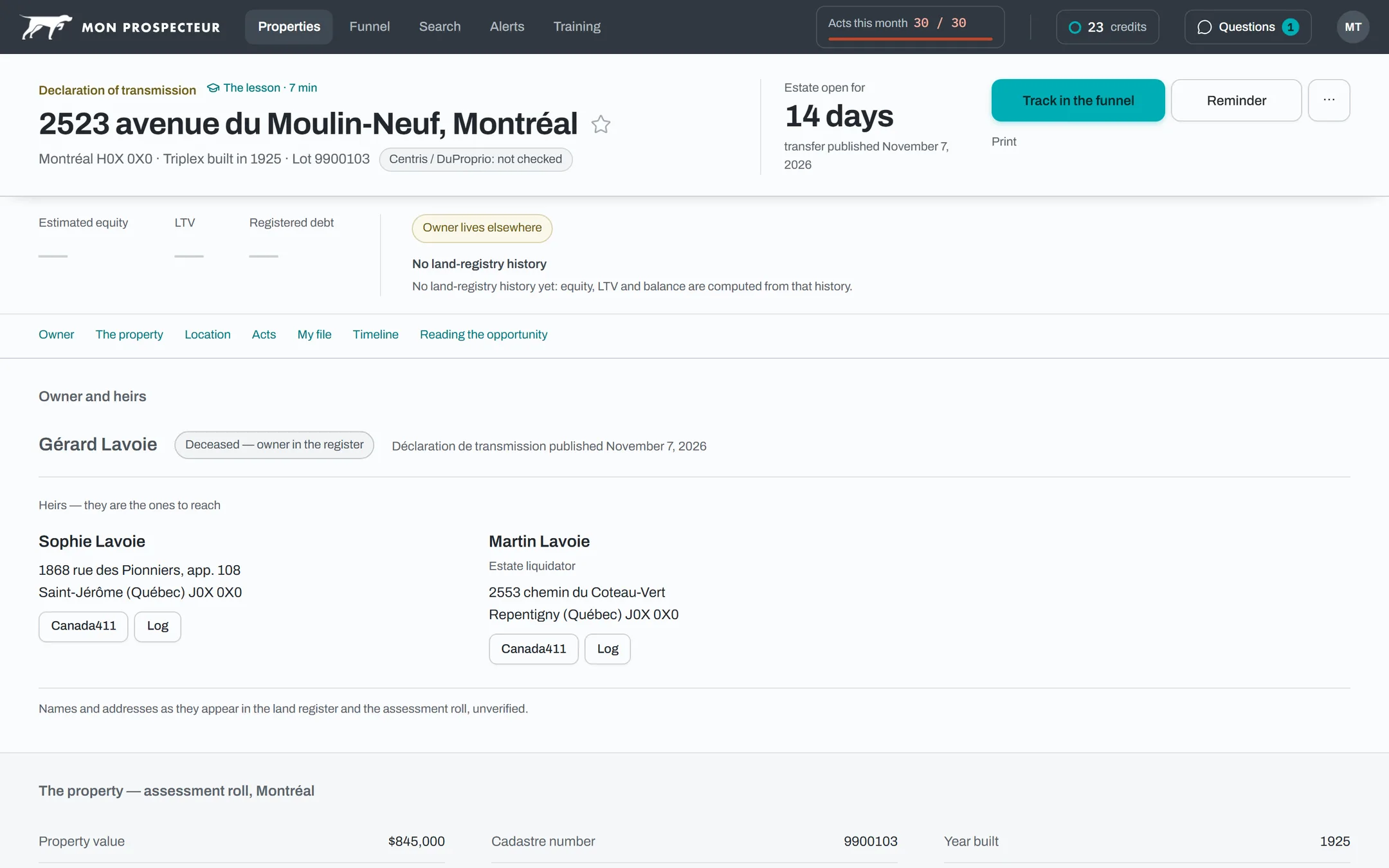
- The declaration the same day, with the deceased, the heirs and the liquidator, read from the act by our AI.
- Their mailing addresses, with the “Owner lives elsewhere” clue when none of them lives there.
- The estate’s age: recent, nearing maturity, matured.
- The registry history, free for a residential property: the mortgage left, the estimated equity and the LTV.
- The mortgage-claim kind recognized and set apart, so you don’t write to the wrong person.
- The funnel’s reminders, to follow an estate for months without losing track.
Frequently asked questions
Should I contact the heirs right away?
Yes, but with tact: a simple letter, no pressure, offering a solution. Then keep the estate in your follow-ups: many are decided six months or a year later.
Who do I contact: the heirs or the liquidator?
The heirs are the owners; the liquidator settles the estate and often knows what they intend. Writing to both does no harm. Mon Prospecteur gives you their names and mailing addresses.
Is a year-old estate still worth it?
Often more than on day one. An empty house is expensive; after a winter looking after it, many heirs are ready to sell.
What’s a transmission of a mortgage claim?
The deceased was a lender, not the owner. Their heirs inherited a claim, not a property: the owner hasn’t died and isn’t selling. It’s still a clue that a private loan is registered on the property.
The other acts
- Préavis d’exercice
- Prise en paiement · délaissement
- Hypothèque légale
- Vente pour taxes
- Retrait d’autorisation de percevoir les loyers
A summary written for prospectors, not legal advice. Timelines are rough: they vary from one judicial district, and one file, to the next. For a specific file, talk to a notary or a lawyer.
Card required, nothing charged for 7 days. Cancel anytime.